NFC business card without a subscription: what you pay for
An NFC business card has three parts and a recurring plan usually covers one of them. What to ask a seller before you order cards for a team.
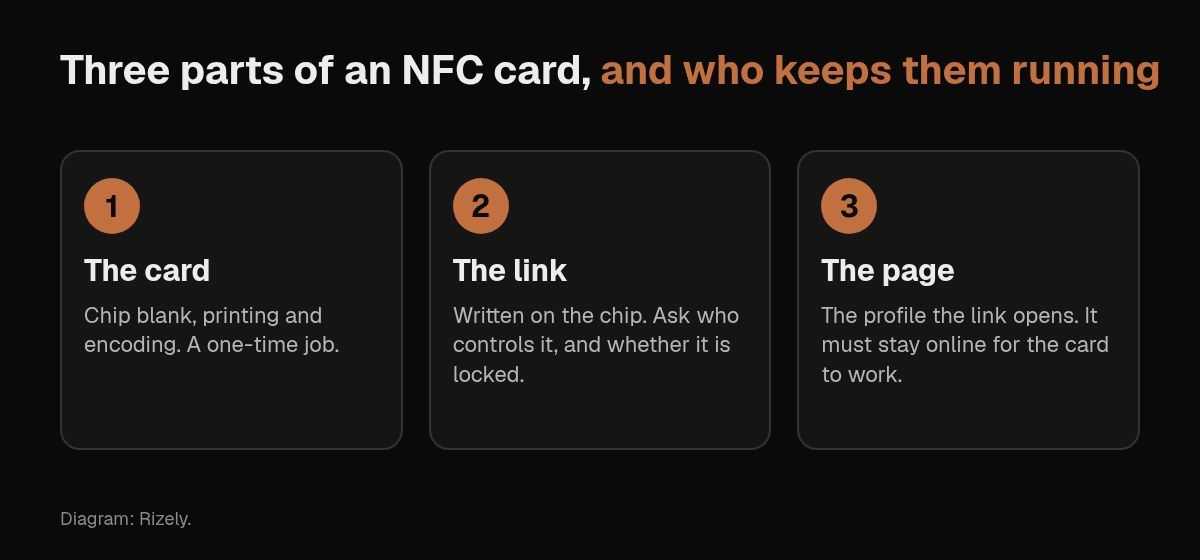
An NFC business card has three parts, and a subscription usually attaches to one of them. You buy the card once. The chip holds one link. That link opens a profile page, and the page is what some sellers charge for year after year. Ask who keeps the page online and what happens to it if you stop paying.
Get that answer in writing before you order, and the rest of the decision is simple.
Key takeaways
- The physical card is a one-time purchase. Printing and encoding are done once.
- The link written to the chip can be locked so nobody rewrites it.
- The profile page behind the link is the part that needs to stay online.
- If a seller ends your page, your card points at a dead address.
- Ask for an export of your contacts and a way to redirect the link.
The three parts you are paying for
Separate the card from the service and the pricing stops being confusing. The table below is the one to take into a sales conversation.
| Part | What it is | One-time or ongoing |
|---|---|---|
| The card | Chip blank, UV printing, chip encoding, delivery | One-time |
| The link | One web address written to the chip as an NDEF record | One-time, unless the seller changes it |
| The page | The profile the link opens, plus hosting and editing | This is the part a plan usually covers |
A card that stops working rarely fails because the chip died. NXP's datasheet rates NTAG213, NTAG215 and NTAG216 chips for 100,000 write cycles and 10 years of data retention. The plastic will scuff before the silicon gives up. What fails is the page at the end of the link.
What a plan usually covers
Sellers bundle different things under a recurring fee, so read the list rather than the headline. A plan commonly pays for hosting the profile page, an editor to change your details, analytics on taps and scans, a lead-capture form, and sometimes a team dashboard where an admin manages cards for staff.
Some of that is worth paying for. If your page carries a contact form that feeds your sales team, somebody has to run it. The question is whether you are paying for a live service or paying rent on a page that never changes.
Team features are where the line sits for most Indian buyers. A company ordering forty cards for a sales force usually does want an admin who can edit a staff member's page when they change role, and who can blank a page the day somebody leaves. That is real work and a fair thing to charge for. A single founder with one card and a fixed number is paying for something quite different, and should price it that way.
Questions to ask before you buy
Ask these five in an email, so the answers are on record:
- Is the chip locked on delivery? A locked chip cannot be rewritten by a stranger with a phone app. An unlocked chip means you can repoint it yourself later.
- Who controls the link? If the address uses the seller's domain, they hold it. If it points at a domain you own, you do.
- What happens to the page if I stop paying? Ask for the answer in plain words: does it go offline, show an upgrade notice, or stay live for reading?
- Can I export the contacts the page collects? Ask for a CSV or vCard export you can run yourself.
- Can I redirect the link later? A seller who will repoint your cards to a new address is giving you a way out.
If the answer to question three is unclear, treat the card as a product with a running cost rather than a one-time purchase and price it that way in your budget.
What happens if the page goes away
This is the honest risk with every digital card, ours included. The chip holds an address. If nothing answers at that address, the tap opens an error page and the card is decoration. A buyer who taps your card eight months after a show and sees a broken page forms a view about your company in that second.
Two things reduce the risk. A locked chip pointing at a domain you control means you can move the page without touching the cards. A regular export means the contacts collected through the page sit in your own file, so a bad month with a supplier costs you a page rather than a pipeline.
How to keep control of your link
Order a small batch before you commit to a team-wide run, and test the tap on an iPhone and an Android handset as described in how NFC business cards work. Keep a written note of the exact URL encoded on your cards. If you ever change suppliers, that string is what a redirect needs.
Keep your own copy of what is on the page as well. A short document with your name, designation, both numbers, email and company details means you can rebuild the page anywhere in ten minutes. It sounds obvious until the day you need it and find the details exist in one editor you no longer have access to.
For the printing and encoding side of the same decision, read how an NFC business card is made. For what belongs on the page itself, see what to put on a digital business card.
Where Rizely stands
We sell the card as a product and we keep the profile that it opens. Our commitment is written on the card page and repeated here, because a promise that moves is worth nothing to someone ordering fifty cards for a sales team.
Rizely makes NFC business cards with a digital profile that is free forever*, and runs an AI agent on WhatsApp and Telegram that reads the visiting cards you collect and drafts follow-ups for you to approve.
*We commit to keeping your Rizely digital profile free for at least 10 years. Want to see a sample profile? Write to [email protected] and we will share access to your email ID.
Shop NFC cards or compare the two formats in NFC card vs paper visiting card. For the wider buying guide, see choosing an NFC business card in India, or browse more Rizely guides.
Frequently asked
Do NFC business cards need a subscription?
The card itself does not. What may need a plan is the profile page the card's link opens, because somebody has to host and maintain it.
What happens to my NFC card if I stop paying?
It depends on the seller. Ask in writing whether the page goes offline, shows an upgrade notice, or stays live for reading, before you order.
Can I change the link on my NFC card later?
That needs an unlocked chip, or a seller who offers a redirect. A locked chip keeps the link fixed, which is safer but less flexible.
How long does an NFC business card chip last?
The NXP datasheet rates NTAG213, NTAG215 and NTAG216 chips for 100,000 write cycles and 10 years of data retention. The plastic usually wears out before the chip.
Is a lifetime NFC card really lifetime?
Ask what the word covers. Many offers mean the plastic is yours forever while the hosted page behind the link is a separate arrangement.
Is the Rizely digital profile free?
Yes. Rizely commits to keeping your digital profile free for at least 10 years. Write to [email protected] if you want to see a sample profile.
Keep reading
 NFC Cards
Digital business card in India: what to put on it and how to choose one
The nine fields that belong on a digital business card, six questions to ask before you order for a team, and the Indian details most products get wrong.
5 min read Cards Agent
Scan visiting cards on WhatsApp: what to do with the cards you collect
Send a card photo in a chat, get the contact back as fields, attach a voice note with the booth context, and approve the follow-up before it is sent.
5 min read