How an NFC business card is made: blanks, UV print, chip encoding
How an NFC business card is made, step by step: chip-loaded blanks, UV printing and curing, encoding the profile link and QR, and the checks before shipping.
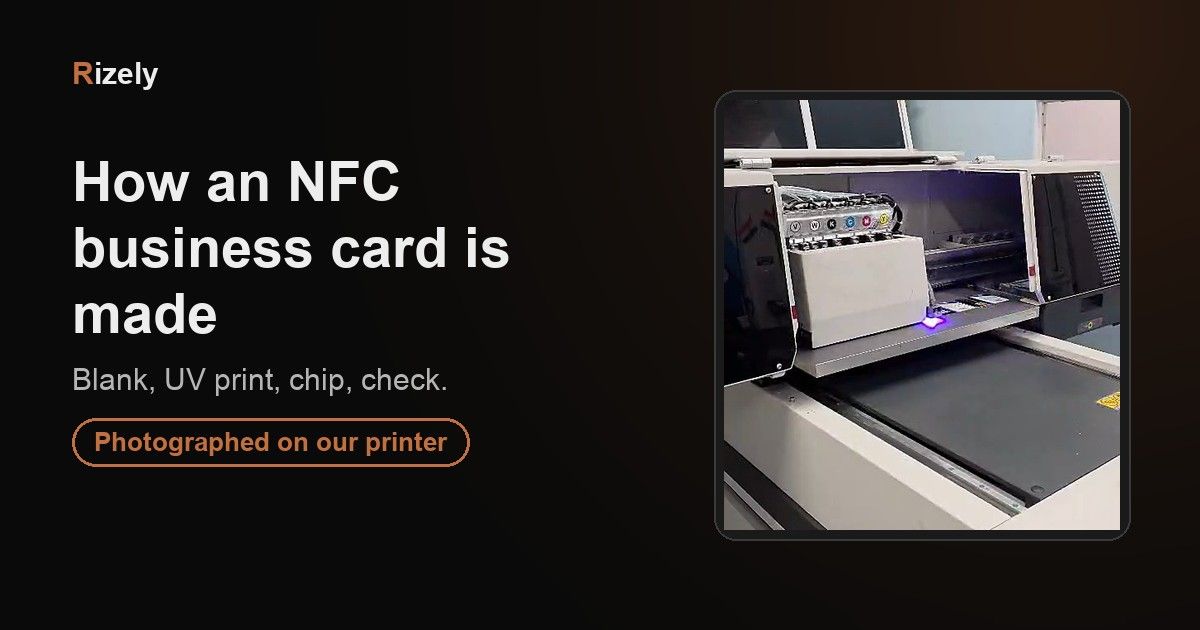
NFC business cards are made in four steps. A blank plastic card arrives with an NFC chip and antenna already sealed inside. A UV printer puts your design on the surface and cures it. Encoding writes one web link to the chip. Then every card gets a tap test and a scan test before it is packed.
Knowing those four steps helps you spot a weak card before you hand it to a buyer at your next stall.
Key takeaways
- The chip and antenna are sealed inside the blank. You never see them.
- UV ink hardens under ultraviolet light within moments, so it grips smooth PVC.
- The chip holds one link to your profile. Your contact details live on that page.
- Test the tap and the QR code on every card before the box is packed.
- Most faults you can catch at the office cost you a lead at the stall.
Card blanks
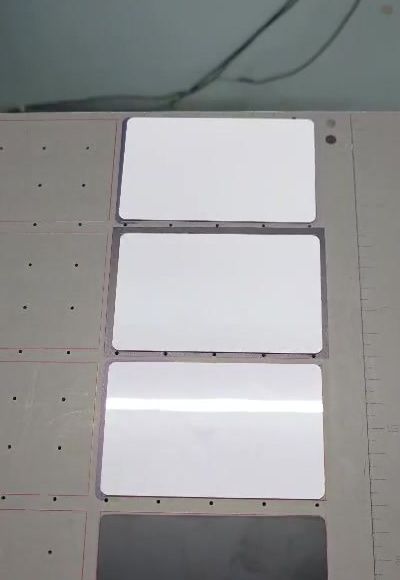
A card blank is a plastic card in the ID-1 size defined by ISO/IEC 7810, 85.60 mm by 53.98 mm, the same size as a bank card. The NFC chip and its antenna are laminated inside before any printing starts. That size is why the card slides into a wallet slot and why it feels heavier than paper.
What is inside the blank
Between the layers of plastic sit a small NFC chip and a coiled antenna of copper or aluminium wire. The antenna picks up power from a phone held close by, so the card needs no battery and never has to be charged. From the outside, a good blank looks like plain plastic with no bump and no outline.
What to check when you buy blanks
If you are still weighing materials, start with our guide to choosing an NFC business card in India. For the blank itself, check three things:
- Chip model. Ask which chip is inside. An NXP NTAG213, NTAG215 or NTAG216 is the common choice.
- Surface. It should be flat and clean. Dust or a raised edge shows up as a flaw once ink goes on.
- Colour. White blanks give the truest colours. Dark blanks suit light ink and a simple layout.
UV printing
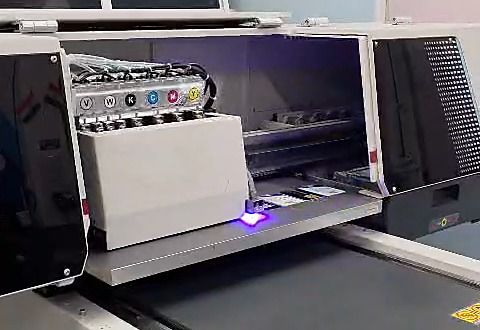
UV printing uses ink that stays liquid until ultraviolet light hits it, then hardens almost at once. Cured UV ink bonds to smooth PVC. Ordinary ink would sit on top of the plastic and rub off inside a bag. The blanks lie flat on the bed of a flatbed UV printer while the print carriage passes over them.
How curing works
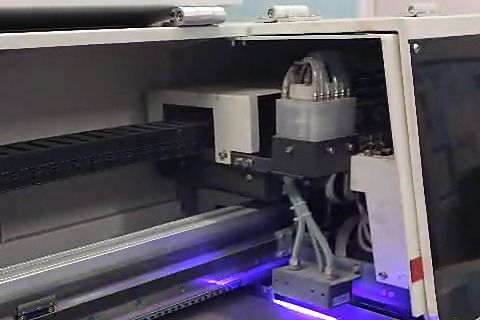
The carriage moves along a rail and jets tiny drops of ink onto each card. On most flatbed UV printers a lamp rides on the carriage beside the print heads, so the ink cures within moments of landing. There is no drying rack. A finished card can be stacked straight away without smudging the one below it.
What decides print quality
- A white base on dark blanks. On a black card there is usually a white base layer under the colours, otherwise they look muddy.
- Text size. Thin, small type fills in. Keep your name and number readable at arm's length.
- QR sharpness. The QR code prints in the same pass as the design, so sharpness matters most here.
Cured UV ink holds up well to daily handling in a wallet, a lanyard pouch or a laptop bag. It is still ink on plastic, so a card that spends a year loose in a bag with keys will show scuffing along the edges.
Encoding the chip and QR code
Encoding writes one web link to the chip as an NDEF record, the data format published by the NFC Forum that NFC phones read without an app.
According to the NXP NTAG213/215/216 datasheet, these chips run at 13.56 MHz and hold 144, 504 or 888 bytes of user memory. A profile link needs a few dozen bytes, so even the smallest of the three has room to spare.
What the chip stores
A phone held near the card powers the chip, reads the link and opens it in the browser. Your name, number and company live on the profile page behind that link, so the chip itself stays tiny. The same datasheet rates these chips for 100,000 write cycles and 10 years of data retention.
| Chip | User memory | Enough for one profile link? |
|---|---|---|
| NTAG213 | 144 bytes | Yes, for a typical short profile URL |
| NTAG215 | 504 bytes | Yes, with plenty to spare |
| NTAG216 | 888 bytes | Yes, more than a link needs |
Locking the chip
The NXP datasheet describes a permanent lock. Once a chip is locked nobody can rewrite its link, so a stranger with a phone app cannot point your card somewhere else. Your details sit on the profile page rather than on the chip, so you can still edit them after locking. Ask your supplier whether cards ship locked or unlocked, and what that means for a card you own outright.
Why the QR code is printed too
The QR code opens the same link for phones that cannot tap. Some phones have NFC switched off, and a thick case can weaken the signal. The ISO/IEC 18004 QR standard calls for a clear quiet zone around the code, so a good layout keeps that margin empty of logos and text.
Quality checks before a card ships
A card that looks perfect can still fail at the stall. Four checks catch most problems before a card is packed, and they take under a minute per card:
- Tap test. Tap the card on an iPhone and on an Android phone. The profile should open on both, with no app installed.
- Scan test. Scan the QR code with a regular phone camera in normal room light.
- Print check. Look for banding, smudges, faded colour or a design that drifts off the edge.
- Link check. Confirm the link opens your own profile page rather than a template page.
Ordering for a team? Test one card for every name before the box goes into anyone's bag. A wrong link is a five-minute fix at the office and a lost lead at the stall. If you want to understand what the buyer's phone is doing during that tap test, we cover it in how NFC business cards work.
After the card is in your hand
The card gets your details onto a buyer's phone. Their details still come back to you on paper. At most Indian shows you will collect visiting cards printed in English, Hindi, Tamil or other scripts, often with two mobile numbers and a company legal name that differs from the brand on the logo.
Rizely makes NFC business cards with a digital profile that is free forever*, and runs an AI agent on WhatsApp and Telegram that reads the visiting cards you collect and drafts follow-ups for you to approve. The agent reads English plus 8 Indian scripts and files each contact under the event where you met.
*We commit to keeping your Rizely digital profile free for at least 10 years. Want to see a sample profile? Write to [email protected] and we will share access to your email ID.
Want a card of your own? Shop NFC cards. For the paper side of the same question, read NFC card vs paper visiting card, or browse more Rizely guides.
Frequently asked
How are NFC business cards made?
A blank plastic card arrives with the NFC chip and antenna sealed inside. A UV printer prints the design and cures it, the chip is encoded with one web link, then the card is tap tested and scan tested before packing.
Where is the NFC chip in a business card?
The chip and its antenna coil are laminated between the layers of the card blank, so you cannot see them. The design is printed on the outside surface afterwards.
What is stored on an NFC business card chip?
Usually one web link, written as an NDEF record that any NFC-capable phone can read. Your details live on the profile page the link opens, so you can update them without reprinting.
Which chip is used in NFC business cards?
Most use an NXP NTAG213, NTAG215 or NTAG216. The NXP datasheet rates them at 13.56 MHz, 100,000 write cycles and 10 years of data retention.
Why is UV printing used for NFC cards?
UV ink hardens the moment ultraviolet light hits it, so it bonds to smooth PVC instead of sitting on top. The print resists rubbing in a wallet or a bag.
Can someone rewrite the link on my NFC card?
Not if the chip is locked. NTAG21x chips support a permanent lock, after which the stored link cannot be changed.
Keep reading
 NFC Cards
NFC business card without a subscription: what you pay for
An NFC business card has three parts and a recurring plan usually covers one of them. What to ask a seller before you order cards for a team.
5 min read NFC Cards
Digital business card in India: what to put on it and how to choose one
The nine fields that belong on a digital business card, six questions to ask before you order for a team, and the Indian details most products get wrong.
5 min read