NFC card vs paper visiting card: which one should you carry?
A decision table for Indian expos and meetings: when an NFC card beats a paper visiting card, when paper still wins, and the simple rule for carrying both.
Carry an NFC card when your details change, when you meet many people in a day, or when you want to land on the buyer's phone while you are still talking. Carry paper when the room is formal, when phones are away, or when someone wants to write on the back. Most teams carry both.
This guide gives you a decision table, the cases where each one wins, and a simple rule for carrying both without looking indecisive.
Key takeaways
- An NFC card points to a page you can edit, so a number change costs nothing.
- One NFC card serves a whole show. You keep it after every tap.
- Paper works with no phone and no signal.
- A buyer who cannot tap can scan the QR code printed on the same card.
- Neither card captures the visiting cards that other people hand you.
The quick decision table
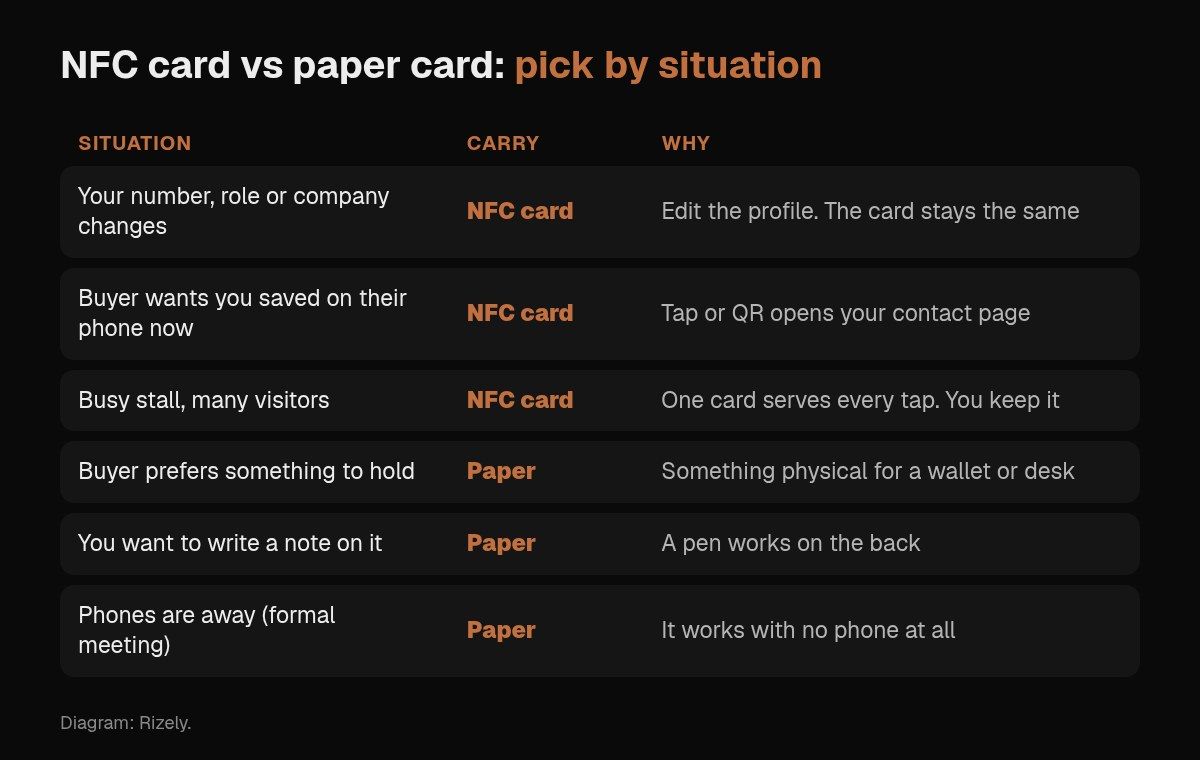
Pick by situation rather than by principle. The table below covers the six moments that come up most often on an Indian exhibition floor and in day-to-day sales meetings.
| Situation | Carry | Why |
|---|---|---|
| Your number, role or company changes | NFC card | Edit the profile page. The card in your pocket stays the same |
| A buyer wants you saved on their phone now | NFC card | A tap or a QR scan opens your contact page straight away |
| A busy stall with a queue of visitors | NFC card | Every visitor taps the same card and you keep it |
| The buyer prefers something to hold | Paper | Something physical for a wallet, a file or a desk drawer |
| You want to write a note on the back | Paper | A pen works. A plastic card does not take ink well |
| A formal meeting where phones are away | Paper | It works with no phone in the room at all |
When an NFC card wins
An NFC card wins any time the details behind it are likely to move. Your office shifts, a designation changes, a new WhatsApp number comes in. With paper you reprint the box. With an NFC card you edit one page and every card already in circulation shows the new details, including the ones you handed out last year.
It wins again on volume. A paper card leaves your hand and is gone. An NFC card stays with you through fifty taps, so a single card can cover three days at a stall without you watching the stock run down by Saturday afternoon.
There is a quieter advantage too. Because the details sit on a page rather than on the plastic, you can put more on the page than would ever fit on a card: a catalogue link, a location, a short line about what you actually supply. The card stays clean and the page does the explaining.
At a busy stall
A queue is where the difference shows. You hold the card, the visitor holds their phone, and the save takes about four seconds without either of you writing anything down. You never run out mid-afternoon, and you are not kneeling behind the table digging a fresh box out of a bag while two buyers wait.
The honest catch is that it needs the visitor's phone to cooperate. Android's documentation notes that devices look for tags when the screen is unlocked, unless NFC is switched off in Settings.
Apple's documentation limits background tag reading to iPhone XS and later. When a phone falls outside either case, point at the QR code and carry on.
When paper still wins
Paper is the right card in a few common situations, and pretending otherwise costs you credibility in the room. In a formal meeting where phones are face down on the table, a paper card passed across is the expected move. Senior buyers in traditional Indian industries often file a card physically, and a plastic card they cannot keep breaks that habit.
Paper also wins whenever someone wants to annotate it. A buyer writes "quote by Tuesday, 500 units" on the back of your card and that note travels with your name to their desk. It wins at a factory gate, in a basement hall with weak signal, and in any room where somebody's phone is out of charge by 4 pm.
Carry both: the simple rule
Keep the NFC card in your hand for walk-ups and queues. Keep a thin stack of paper in your inside pocket for sit-down meetings and for anyone who asks for something to keep. Print a QR code on the paper card that points to the same profile page as the chip, so the two carry identical details and you maintain one page rather than two sets of information.
That one change solves the usual complaint about paper. The card still gets filed, and the person who files it can still reach a current page six months later when the printed number has gone stale. For the mechanics behind that page, see how NFC business cards work.
What neither card does
Both cards point outward. Across three days at a show your team will come back with a bag of paper visiting cards that other people handed over, in English, Hindi, Gujarati, Marathi or Tamil, many with a calling number and a separate WhatsApp number. Those cards sit in a drawer until somebody finds an afternoon to type them in, and by then nobody remembers which booth the conversation happened at.
Rizely makes NFC business cards with a digital profile that is free forever*, and runs an AI agent on WhatsApp and Telegram that reads the visiting cards you collect and drafts follow-ups for you to approve.
*We commit to keeping your Rizely digital profile free for at least 10 years. Want to see a sample profile? Write to [email protected] and we will share access to your email ID.
Shop NFC cards when you are ready.
To handle the pile that comes back with you, read how to scan visiting cards on WhatsApp. If you are weighing the running cost, see NFC business card without a subscription, or browse more Rizely guides.
Frequently asked
Is an NFC business card better than a paper visiting card?
It depends on the situation. An NFC card is better when your details change or a buyer wants you saved on their phone. Paper is better in formal meetings, for handwritten notes and when phones are away.
Do I still need paper visiting cards if I have an NFC card?
Most people keep a few. Paper works without a phone or a signal, and some buyers prefer a card they can file.
Can I give my NFC card away?
You can, but you do not have to. The visitor taps the card and you keep it, so a single card serves a whole show.
What if the other person's phone cannot read NFC?
They scan the QR code printed on the card with the phone camera, which opens the same profile page.
Can my paper visiting card and NFC card show the same details?
Yes. Print a QR code on the paper card that points to the same profile page as the chip, then update that one page.
How many NFC cards does a booth team need?
One per person is usually enough, because the card stays with you after every tap. Carry a thin stack of paper for sit-down meetings.
Keep reading
 NFC Cards
NFC business card without a subscription: what you pay for
An NFC business card has three parts and a recurring plan usually covers one of them. What to ask a seller before you order cards for a team.
5 min read NFC Cards
Digital business card in India: what to put on it and how to choose one
The nine fields that belong on a digital business card, six questions to ask before you order for a team, and the Indian details most products get wrong.
5 min read