Event badge scanner vs card capture on chat: what each one actually catches
A badge scanner catches registered visitors. Card capture on chat catches anyone with a card. Here is which visitors each one misses at an Indian show.
An organiser's badge scanner reads the QR code on a registered visitor's badge and returns the record the organiser holds. Card capture on chat, in WhatsApp or Telegram, reads a photo of a paper visiting card and returns the contact plus what you say about the conversation. They catch different people.
The useful question is not which tool is better. It is which visitors each one misses.
Key takeaways
- A badge scanner works when the visitor is registered and wearing the badge.
- Card capture works on any card, including one handed across a counter.
- Badge data usually lives on the organiser's platform for a limited window.
- Chat capture keeps the history in a chat you already own.
- Indian-script cards and dual numbers are where the two diverge most.
What a badge scanner does
An organiser issues every registered visitor a badge with a QR code. Exhibitors rent a scanner or an app for the show, scan the badge, and receive the visitor record the organiser holds: usually name, company, designation and an email. It is fast, it needs no typing, and the data quality is as good as the registration form the visitor filled in weeks earlier.
It is the right tool for the registered footfall walking your aisle. It is also usually a rental tied to one show, with access to the data for a defined period after the halls close.
What card capture on chat does
You photograph a paper visiting card inside a WhatsApp or Telegram chat and an AI agent returns the contact as structured fields. You add a voice note with the context, and the agent files both under the event. The capture runs on the phone already in your hand, so every person on the stand can do it without renting a device.
It also keeps working after the show. The chat history and the exported sheet stay with you, so a card you photographed on a Saturday is still searchable in March. We go through the workflow in how to scan visiting cards on WhatsApp.
Side by side
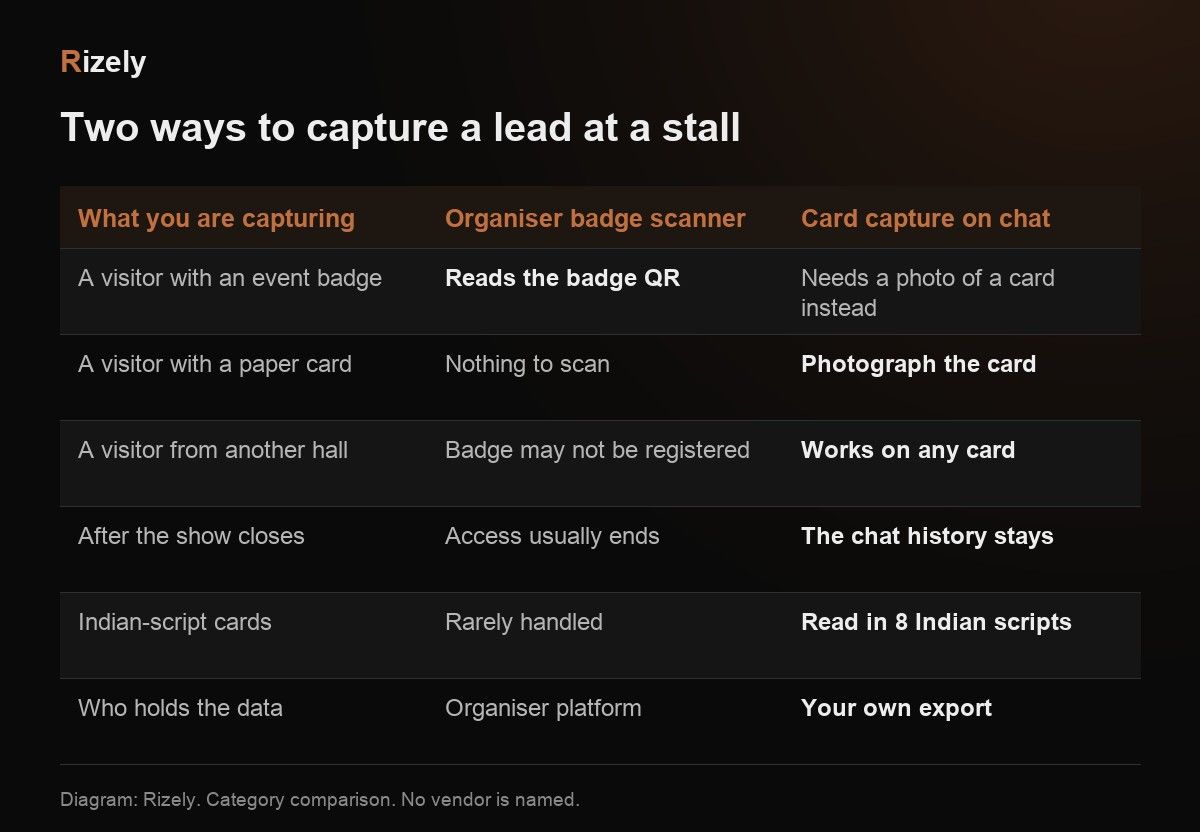
| What you are capturing | Organiser badge scanner | Card capture on chat |
|---|---|---|
| A registered visitor wearing a badge | Reads the badge QR | Needs a photo of their card instead |
| A visitor who hands over a paper card | Nothing to scan | Photograph the card |
| A walk-in from a neighbouring hall | May not be in the register | Works on any card |
| A card in Hindi, Gujarati or Tamil | Rarely part of the badge data | Read in 8 Indian scripts |
| Two numbers on one card | Depends on the registration form | Both captured and labelled |
| Context from the conversation | Usually a tick box or a short note | A voice note attached to the contact |
| After the show closes | Access typically ends with the licence | The chat and the export stay with you |
| Who holds the data | The organiser's platform | Your own sheet and export |
Where each one breaks
A badge scanner breaks on anyone outside the register. At most Indian B2B shows a real share of your best conversations are with people who walked in on a day pass, came with a colleague's badge, or are exhibiting two aisles away and never registered as a visitor at all. None of them scan.
Card capture breaks when nobody hands you a card. Plenty of visitors arrive with nothing printed, and for those the badge is the faster route. It also depends on photo quality, so a glossy card under a hall spotlight needs a second look before you move on.
Both break on the same thing at the end: a file of contacts that nobody follows up. The tool that captures the lead has never been the constraint. The constraint is whether anyone remembers what was promised at the counter.
Most booth teams run both
The sensible setup at a show of any size is a badge scanner on the counter for registered footfall and card capture on every team member's phone for everything else. The two sit together well, because they fail in opposite directions. Organiser platforms give you the registered audience; a card-capture agent gives you the paper and the conversation.
What matters is that both end up in one sheet by the evening, with the event name on every row. Two exports that never get reconciled are two half-pipelines, and the Monday meeting works out of neither.
Questions to ask the organiser before you rent
Ask these in writing when you book your stand:
- How many scanner licences are included, and what does an extra one cost? Multi-person stands often discover this on setup day.
- Which fields come back? Name and company alone will not let you follow up properly.
- How long do you keep our access open after the show? Put the date in your calendar the day you get the answer.
- Can we export to CSV ourselves? A dashboard with no export is a dashboard you lose at the end of the month.
- Are visitors told their badge data goes to exhibitors who scan it? You want the consent chain to be clean before you message anyone.
How to measure the show afterwards
Count four numbers per show: cards and badges captured, contacts reached within a week, replies, and meetings booked. Keep them per event rather than per month, because the way to decide whether a stand was worth the money is to compare like shows against each other.
If you are choosing what to hand out at the same stand, read NFC card vs paper visiting card and what to put on a digital business card.
Rizely makes NFC business cards with a digital profile that is free forever*, and runs an AI agent on WhatsApp and Telegram that reads the visiting cards you collect and drafts follow-ups for you to approve.
*We commit to keeping your Rizely digital profile free for at least 10 years. Want to see a sample profile? Write to [email protected] and we will share access to your email ID.
Open your dashboard to try it with 50 free scans, or Shop NFC cards. Meeting us in person? We are at Tech Expo Gujarat 2026. More in our guides.
Frequently asked
What is an event badge scanner?
A device or app that exhibitors rent for a show. It reads the QR code on a registered visitor's badge and returns the visitor record the organiser holds.
What does a badge scanner miss?
Anyone outside the register: day-pass walk-ins, visitors using a colleague's badge, and exhibitors from other stands who never registered as visitors.
What is card capture on chat?
Photographing a paper visiting card inside a WhatsApp or Telegram chat so an AI agent reads the contact, files it under the event and drafts a follow-up.
Should an exhibitor use both?
At most shows, yes. A badge scanner covers the registered footfall and card capture covers the paper and the conversation. They fail in opposite directions.
What should I ask the organiser before renting a badge scanner?
How many licences are included, which fields come back, how long your access stays open after the show, whether you can export CSV yourself, and how visitor consent is handled.
How do I measure whether a show was worth it?
Count four numbers per event: contacts captured, contacts reached within a week, replies, and meetings booked. Compare like shows against each other.
Keep reading
 NFC Cards
NFC business card without a subscription: what you pay for
An NFC business card has three parts and a recurring plan usually covers one of them. What to ask a seller before you order cards for a team.
5 min read NFC Cards
Digital business card in India: what to put on it and how to choose one
The nine fields that belong on a digital business card, six questions to ask before you order for a team, and the Indian details most products get wrong.
5 min read